Tips & Guides
Landscaping in the Hills District, What the Ground Here Demands
What makes landscaping in the Hills District different?
Landscaping Hills District blocks means working with slope, clay and shale, and those three conditions decide most of what is possible before anyone chooses a paver. Get the levels, the retaining and the drainage right and everything on top of them lasts. Get them wrong and the finish fails within a few seasons, no matter what it cost.
Infocus Land Solutions is based at Box Hill and builds across the Hills, so this is the ground we work on every week. Here is what it demands.
Slope is the first constraint
Very few Hills blocks are flat, and the ones that look flat usually are not.
The land through Kellyville, Rouse Hill, Box Hill and Castle Hill rolls. A backyard with a metre of fall across it does not have a usable lawn until something holds the ground. That is why so many Hills projects begin with retaining and terracing rather than with planting: you are not decorating a yard, you are making a flat area exist.
Terracing a sloped block into two or three usable levels is often the single highest value move available, because it turns unusable ground into somewhere you would actually sit. Steps between the levels then need to feel natural rather than bolted on, which is a design decision made early, not a fix applied late.
What does clay soil change?
Almost everything about drainage, and therefore almost everything about what you build.
Hills clay holds water. After a wet week it stays saturated, and saturated clay behind a wall is heavy, which is why retaining walls here need drainage designed into them rather than added afterwards. Then in a dry month the same clay shrinks and sets hard, and water runs off the surface instead of soaking in.
The practical consequences: subsoil drainage behind every retaining wall, falls that take surface water away from the house rather than towards it, and base preparation under paving that assumes the ground beneath it will move. Skip those and you get the classic Hills failures, a bulging wall, a soggy corner of lawn that never dries, and pavers that sink at one end.
 Pebble path with stepping stones and timber sleeper planter beds by Infocus Land Solutions
Shale is the other local surprise. Plenty of Hills blocks have it not far under the topsoil, and hitting it changes excavation from a straightforward dig into something that needs the right machine. It is better to find out at quoting stage than at invoicing stage.
What order should a landscaping project run in?
Bottom up and back to front: excavation and levels, then structure, then drainage, then hard surfaces, then soft landscaping last.
- Excavation and levels. Establish the finished heights before anything is built to them.
- Retaining and structure. Walls, footings and terracing, because everything else sits on the ground they hold.
- Drainage. Subsoil, surface falls and stormwater connections, installed while trenches are open and access is clear.
- Hard surfaces. Paving, paths, driveways, steps, decking and pergolas.
- Soft landscaping. Turf, planting, edging, mulch and gravel.
Running that order out of sequence is the most expensive mistake in residential landscaping. Laying turf before drainage means lifting turf to install drainage. Paving before you are certain of the finished levels means cutting the paving out.
Do you need approval for retaining walls in the Hills?
Often yes, and it turns on wall height, proximity to boundaries and whether the wall is doing structural work.
Low garden edging generally sits outside approval. A wall of any real height, a wall near a boundary or a wall supporting a driveway or a neighbour's ground usually needs engineering, and frequently needs council consent. The NSW Planning Portal sets out what falls under exempt and complying development, and The Hills Shire Council publishes the local controls that apply here. It is worth resolving that at design stage, because a wall built without the approval it needed becomes your problem at sale time.
Our guides to what a retaining wall costs in NSW and sleeper versus besser block walls cover how the choice plays out on a Hills block.
What should you ask a Hills District landscaper?
Ask how they are handling water, what is going under the hard surfaces, and who is engineering anything structural. Those three answers tell you most of what you need to know.
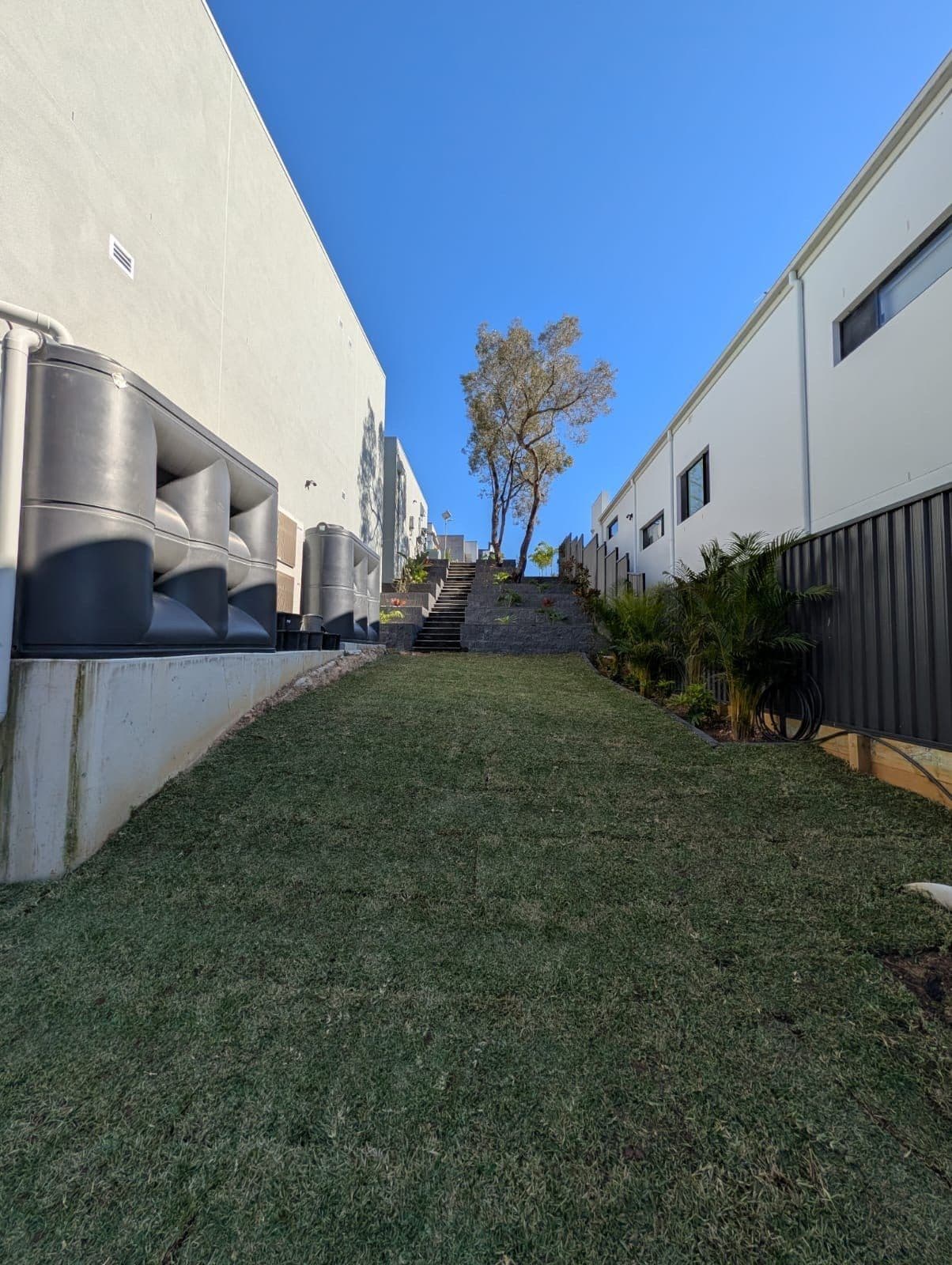
 Terraced block retaining walls and stairs on a steep sloping block, built by Infocus Land Solutions
A landscaper who can describe the drainage strategy for your specific block, name the base depth under your paving and tell you which elements need engineering has thought about your site. One who leads with paver colours has thought about the photo. Both jobs will look the same on handover day. They will not look the same in five years.
Also ask for a written scope before work starts. NSW Fair Trading sets out what home building contracts need to cover and is worth reading before you sign anything.
Which suburbs do you cover?
We work across the Hills District and greater Sydney from our base at Box Hill, including Rouse Hill, Kellyville and Castle Hill, and further afield for larger builds.
The full picture of what we build, from retaining walls and drainage through to decks, pergolas, turf and planting, is on our landscaping and garden design page, and the areas we serve page lists where we work.
Getting started on your block
The useful first step is a site visit. Levels, soil, access and where the water currently goes are all things that have to be seen rather than described, and they set the shape of everything after them.
Send through a few photos of the area and a rough idea of what you want it to do, and we will come and look at the ground properly. Built once, built right.
Talk to Mike
Get an honest quote for your place
0406 100 318A free quote, no obligation, and the price we give is the price you pay.