Tips & Guides
Driveway Paving in Sydney: Costs, Materials and What Goes Wrong
Search driveway paving Sydney and you will find a hundred showrooms and very little about what actually holds a driveway up. That is the problem with this job: the visible half is the easy half. Choosing a paver takes an afternoon. What decides whether that driveway still looks right in ten years happens underneath it, before a single paver is laid, and almost nobody asks about it.
Here is the honest version: what the materials cost, what the base has to do, and the handful of things that go wrong often enough to be predictable.
How much does driveway paving cost in Sydney?
Across the Sydney market in 2026, driveway surfaces typically run from around $40 per square metre for asphalt up to $250 per square metre for natural stone, with clay and concrete pavers commonly sitting in the $80 to $150 per square metre band. A standard single driveway usually lands in the low to mid thousands and a double driveway well above that, depending on finish and site.
Those are published market ranges, not a quote. Every driveway is priced off the block it is going on, because excavation, access, fall and drainage move the number far more than the paver you pick. We quote on site for that reason.
What actually drives the price up?
Four things move a driveway quote more than the paver does, in roughly this order: site access, excavation volume, drainage, and the levels the finished surface has to meet.
- Access. If a truck and a bobcat can reach the work, the job is efficient. If everything has to come through a side gate in a barrow, it is not.
- Excavation. A driveway base is dug deeper than a patio base because it carries vehicle loads. More depth is more spoil, and spoil has to leave the site.
- Drainage. Water that has nowhere to go will find somewhere. Grated drains, subsoil lines and correct falls are real costs and non negotiable ones.
- Levels. Meeting the garage slab, the kerb and the path at the right heights, with fall running away from the house, is what separates a driveway from a puddle.
The quotes that look suspiciously cheap are almost always cheap in one of those four places.
Which paving material is best for a driveway?
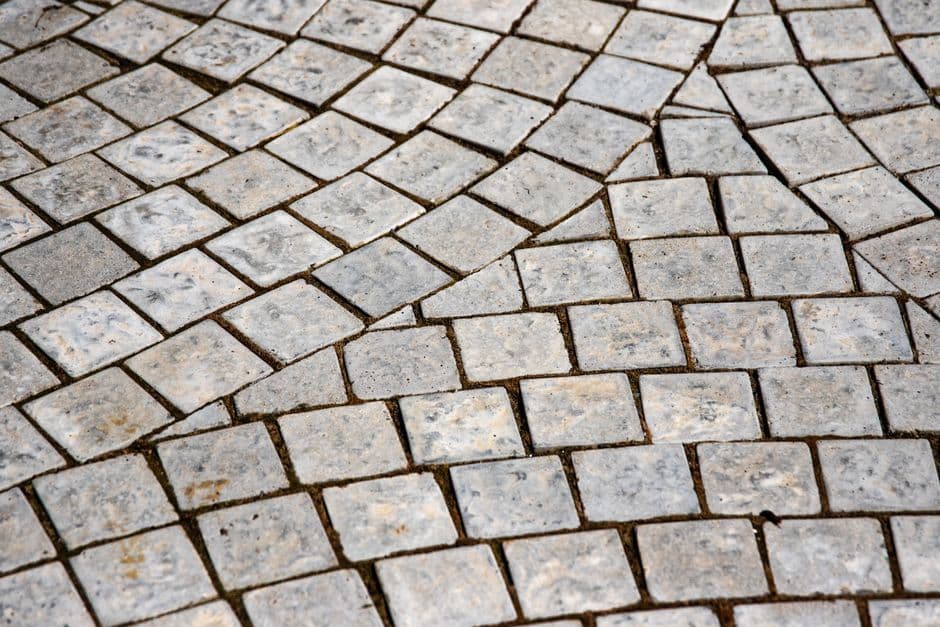
 Close-up of textured brick paver pattern in a herringbone layout.
For most Sydney homes, a concrete or clay driveway paver is the best balance of strength, price and repairability. It handles vehicle loads, comes in a wide range of finishes, and if a section is ever damaged or a service has to be dug up, you lift the affected pavers and relay them rather than cutting and patching a slab.
Natural stone looks superb and costs the most. Porcelain is beautiful underfoot but needs the right thickness and a properly engineered base to take a car. Poured concrete is a fine surface and the cheapest of the hard options to install, but it cracks along its own lines eventually and it is very hard to make a repair invisible. We have gone into surface choice in more depth in our guide to the best pavers for Sydney driveways and patios.
Does the base really matter that much?
It matters more than the paver. A driveway base is a compacted road base layer over a properly prepared subgrade, laid to the right depth, compacted in lifts rather than all at once, then screeded with bedding sand or mortar depending on the system.
Get that wrong and no paver saves you. Rutting under the wheel tracks, a dip at the kerb, pavers rocking underfoot, joints opening up: all of that is base failure showing through the surface. It is also the single most common corner cut in cheap paving, precisely because it is invisible on handover day.
Sydney's shale and clay soils make this sharper again. Clay moves with moisture, so drainage and base depth are doing structural work, not just tidying up.
Do I need council approval to pave a driveway?
Often yes, and the answer depends on your council and on whether you are touching the layback or the nature strip. Resurfacing an existing driveway within your property boundary is frequently minor works, but a new driveway, a new crossing, or any change to the vehicle crossing over the footpath and kerb generally needs council consent.
Check before you start, not after. The NSW Planning Portal sets out what counts as exempt and complying development, and your local council publishes its own vehicle crossing requirements, for example The Hills Shire. If council approval is needed on a job we are quoting, we will tell you at quote stage rather than let you find out later.
How long does a paved driveway take?
Most residential driveways run somewhere between a few days and a couple of weeks on site, driven by size, excavation volume and whether concrete needs curing time before anything can sit on it. Weather adds days. Sydney summer storms in particular can flood an open excavation overnight and cost you a day of drying out.
A realistic program stated up front is a fair test of a contractor. So is what they say when it rains.
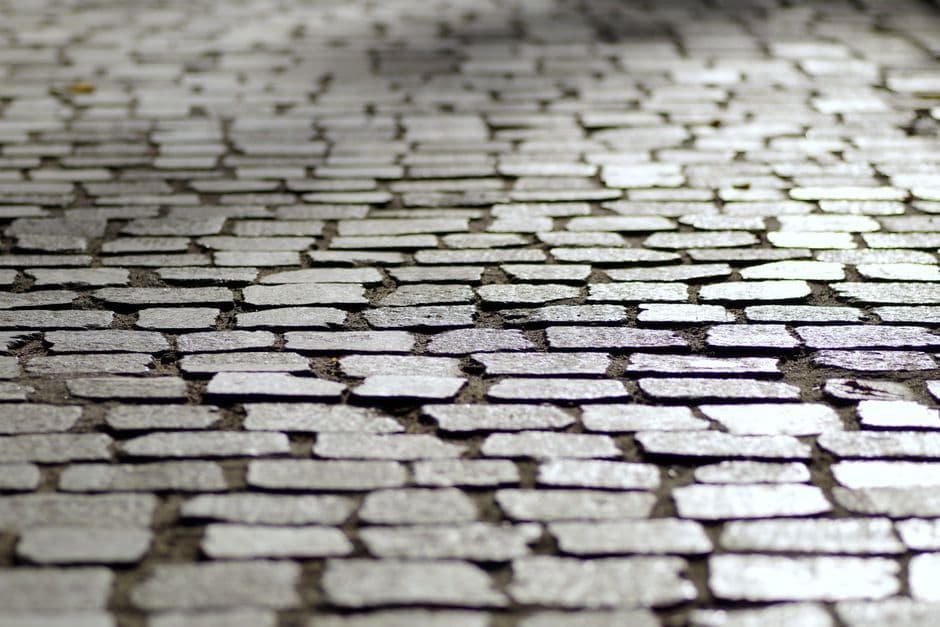
 Close-up of a gray granular asphalt texture ideal for backgrounds and design elements.
What goes wrong with driveways in Sydney?
Almost every driveway failure we get called to look at traces back to the base or the drainage, and the same five faults come up again and again:
- Base too shallow for vehicle loads, so wheel tracks sink within a season.
- Falls set toward the house or garage instead of away from it.
- No drainage at the low point, so the garage floods in the first real downpour.
- Edge restraints missing, so the outer courses creep sideways and the joints open.
- Jointing sand washed out and never topped up, which starts the same creep more slowly.
None of those are exotic. All of them are cheaper to prevent than to repair, and every one of them is a base or drainage decision made before the surface went down.
How do you keep a paved driveway looking good?
Sweep it, keep the joints full, and deal with oil promptly. Top up jointing sand every few years, or use a polymeric jointing sand that resists washout. Sealing is optional and worth it on lighter pavers or where you want the colour to stay saturated, but a sealed driveway needs re sealing on a cycle, so go in knowing that.
Pressure washing is fine, within reason. Held too close it strips the joints out faster than weather does.
Getting it right the first time
A driveway is the first thing anyone sees and the last thing anyone wants to redo. Built once, built right is not a slogan for us, it is a description of where the money should go: into the excavation, the base and the drainage, so the surface you chose still sits flat in a decade.
If you are planning a driveway anywhere across Sydney and the Hills District, have a look at our paving and driveways service, or get in touch and we will come and look at the block. There are more guides here if you are still weighing up materials.
Talk to Mike
Get an honest quote for your place
0406 100 318A free quote, no obligation, and the price we give is the price you pay.